
Read Branch County's Current Owner Record
The public ArcGIS parcel schema confirms how Branch County labels its owner and parcel fields. For current assessment data, check the live BSA tax roll.
| OWNER_NAME | The published owner label. |
|---|---|
| OWNER_ADDRESS | The separate mailing address. |
| PARCEL_ADDRESS | The property's situs address. |
| PARCELID | The cross-reference that keeps the search on one parcel. |
| MUNICIPALITY | The city, village, or township attached to the parcel. |
| Newest deed | The recorded instrument used to confirm the latest conveyance. |
An owner and an occupant are not the same thing. A mailing address outside Branch County fits local ownership just fine.
Confirm Branch County's Current Owner
The BSA parcel search is the assessment source of record. Match its owner against the newest relevant instrument in the Register of Deeds deed index.
- Save the parcel ID, owner label, and roll date if displayed.
- Search that owner as grantee in the deed index.
- Match the legal description and compare execution, recording, and roll dates.
- For an LLC, consult the MiBusiness Registry without substituting it for the deed.
- Owner of record
- The party a dated official record identifies as owner.
- Situs
- The physical property location, distinct from owner mail.
- Recording lag
- The interval between closing, recording, and a later roll update.
Separate Owner Address From Property Address
The Branch County parcel-layer schema keeps PARCEL_ADDRESS and OWNER_ADDRESS in separate fields. That split matters. The first points to the land itself. The second shows where mail goes. An owner may live elsewhere, list a business address, or route mail through a trustee. The same layer publishes OWNER_NAME, PARCELID, MUNICIPALITY, and ACRES.
Its metadata carries an October 17, 2019 edit date. Treat the layer as a schema reference rather than a live tax roll, and confirm the current owner in BSA before checking the latest deed.
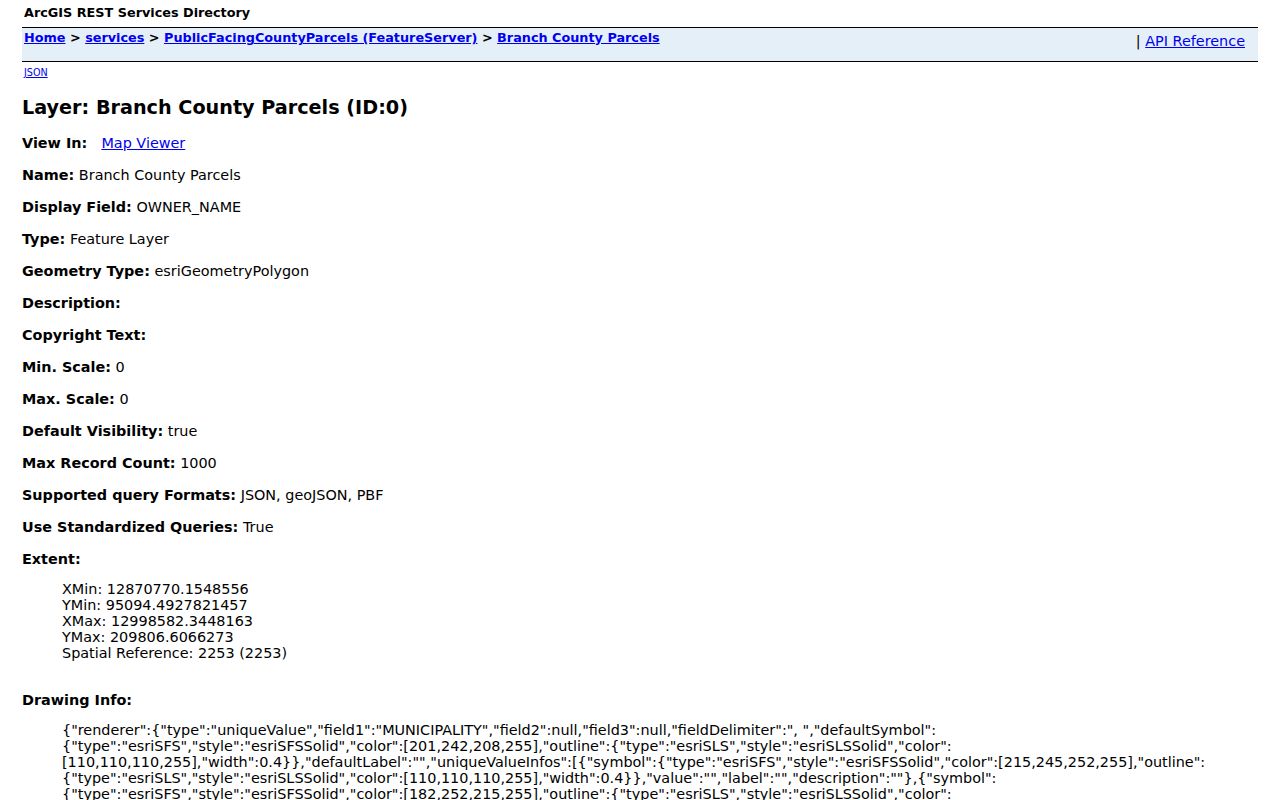
A field inventory keeps the mailing address from getting mistaken for the parcel's actual location in Branch County property records.
Why a Recent Closing May Not Appear Yet
A deed must be executed, delivered, and recorded. It must then be indexed and copied into other county systems on separate schedules. Branch County publishes no fixed lag figure for its assessment roll. Ask the custodian when the displayed roll was last refreshed. Comparing dates settles most discrepancies.
| Date to compare | What it means | Where to check |
|---|---|---|
| Execution date | When the parties signed the instrument | Recorded deed image |
| Recording date | When the Register accepted and indexed it | Register of Deeds index |
| Roll or layer date | Age of the displayed owner label | BSA result or published metadata |
| Tax mailing cycle | When an owner name may appear on a notice | Local collector or Treasurer |
Recent-sale gap. The assessment owner can lag a newly recorded conveyance. For a current-owner question after closing, the newest matching recorded deed is the stronger confirmation.
Read LLC, Trust, and Estate Owner Names
The owner field may name an entity or fiduciary instead of a person. Copy the name exactly. Punctuation matters. Search the variants too. For a Michigan LLC or corporation, the MiBusiness Registry Portal shows entity filings and an official contact. It launched June 23, 2025. A registered agent is a service contact. Owning the Branch County parcel is a different question.
A trust may be indexed under the trust name, the trustee, or both. Estate transfers often call for reading a fiduciary deed, and Branch County Probate Court records can be reached through MiCOURT Case Search or the local clerk. In every case, the legal description and newest deed keep the identity check anchored to the land.
Note: An entity registry explains the organization; it does not replace the recorded deed as the ownership confirmation.
Check Recorder Notes and Missing Connections
The Register of Deeds cautions that some records are missing online and related documents may not be linked. Check the notes field on any entry. A deed that looks corrected, released, or supplemented deserves a second search under both party names near the recording date. Ask the office about any referenced document. Never assume the portal's relationship list is complete.
Online name searching reaches back to 1974 in the index. Liber/page and document-number searching reach back to 1949. Those cutoffs matter for older holdings, when the displayed owner may have acquired the parcel before the name index begins.
Monitor New Branch County Recordings
The Register's Property Fraud Alert tracks recordings by name. It also supports property-related monitoring. Set it up after confirming the current owner. An unexpected alert can then be checked against the official deed index promptly. The alert cannot block a recording or decide its legal validity.
Verify any notice through the Register's published page or office contact. Never use links in an unsolicited message. Keep the parcel ID and recording reference ready. Staff can then separate your property from a similar Branch County record.
Use Branch County Owner Information Lawfully
The mailing field is not an occupancy record. It simply opens a channel for a legitimate property question. People at risk can use Michigan's Address Confidentiality Program.
Lawful use. Use owner records for legitimate property research. Never use an owner name or address to stalk, harass, intimidate, or harm anyone.
When Branch County's Owner Record Is Unclear
Online tools are not the only route. Equalization or the local assessor handles tax roll questions. The Register of Deeds, at 23 East Pearl Street in Coldwater, handles the newest deed, a missing image, or a notes-field problem. Bring the parcel ID, address, owner, and transfer date.
When a nonexempt record resists routine service, Michigan's Freedom of Information Act, MCL 15.231 et seq., permits a written request. Agencies generally respond within five business days. A ten-business-day extension is allowed. Ask for an identifiable existing record in your preferred format. The law does not require an ownership analysis to be created.