
Chart Branch County Former Owners
Chart each transfer from newest to oldest. One row holds the parties, deed type, date, and recorded reference. These fields describe what to record, not a sample title chain.
| Transfer point | Parties | Instrument | Reference |
|---|---|---|---|
| Newest matching deed | Prior owner to current grantee | Warranty, quitclaim, trustee, or other deed | Document number or liber/page |
| Earlier transfer | Earlier owner to prior owner | Type shown in index and image | Recording date and liber/page |
| Estate or court event | Decedent, representative, heir, or buyer | Representative deed or order | Recorder reference plus court file |
| Pre-online link | Historic parties in deed books | Older recorded instrument | Office book and page |
Never guess at a missing owner. Mark the gap until a deed book, plat, probate record, or tax roll connects the same legal description.
Know Branch County Index Cutoffs
The Register of Deeds notice sets two online cutoffs. Party-name searching reaches 1974. Liber-and-page or document-number searching reaches 1949. Those years mark online access, not the start of Branch County land records, and gaps remain: some entries are missing, images are not all online, and related instruments may not be connected. The county's remote one-time route runs through Fidlar Tapestry, whose entry page names the search service and its payment terms.
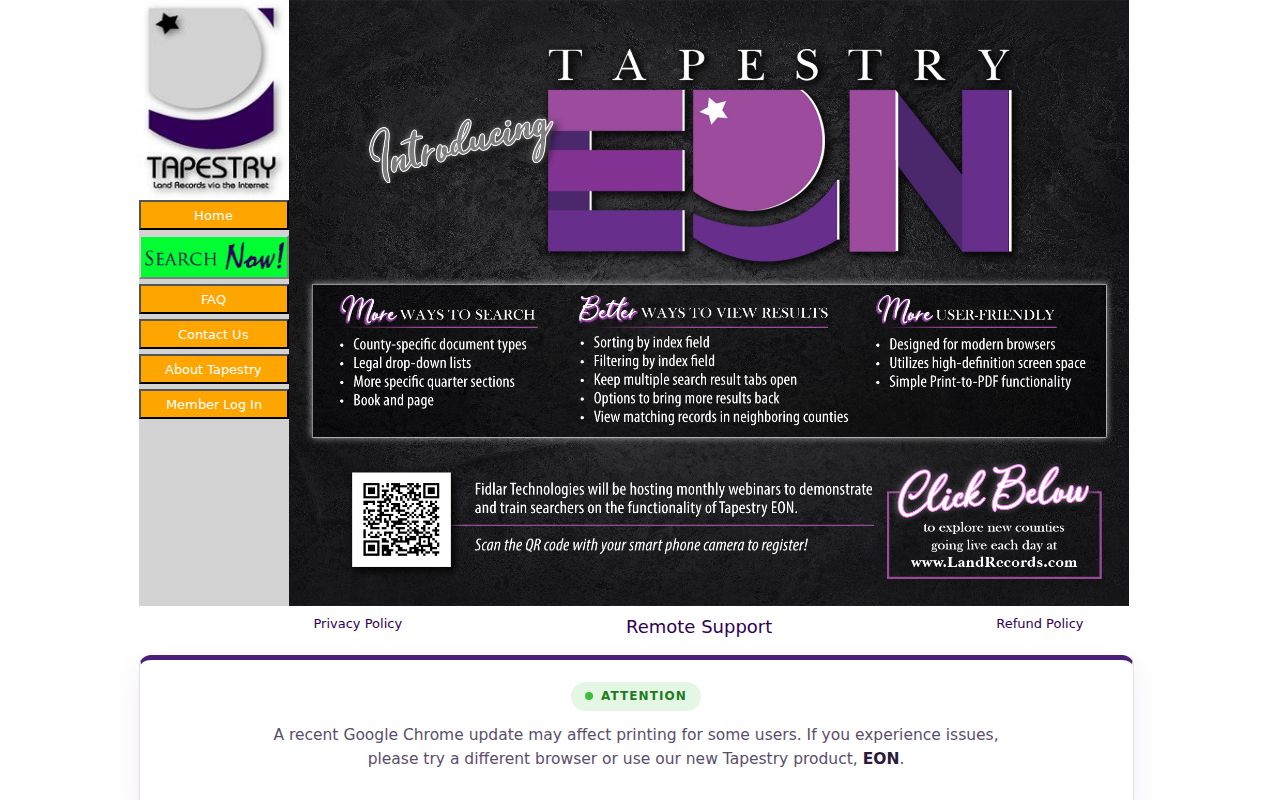
That page names the service. It displays no sample ownership result, so take any known book and page into the older office index at 23 East Pearl Street.
Online cutoff. Name search reaches 1974 and reference-number search reaches 1949. Older former owners require office volumes and historical sources.
Walk Branch Deeds in Reverse
Begin with the newest deed matching the parcel. Confirm the legal description first, because common surnames, trusts, and companies can each hold several parcels.
- Find the current grantee's acquisition deed and match its land description.
- Copy the grantor, recording date, deed type, and reference exactly.
- Search that grantor as an earlier grantee to find the prior acquisition.
- Repeat while the description matches, noting splits, combinations, and replats.
- Carry the final online reference into the Register's physical index.
- Grantor / grantee
- The party conveying an interest and the party receiving it.
- Chain of title
- The ordered sequence of instruments affecting the same land.
- Legal description
- The lot, block, survey, or metes-and-bounds wording that survives address changes.
Follow Branch County Name Variants
Old owners hide behind name changes. A Branch County deed may list initials, a married surname, a trust, an estate, or a corporate name. Search the exact deed spelling first. Then try the likely variants. A trust needs both trustee and trust searches, and an estate needs the decedent, the estate, and the personal representative. Keep the parcel ID, municipality, and legal description beside each result, since a Coldwater, Bronson, or Quincy mailing address can sit outside the city or village line. The county parcel layer separates incorporated land from townships. That separation helps prevent a same-name error.
Note: Branch County advises deed searchers to read the notes field, because a corrective deed, release, or related document may not be linked.
Anchor Prior Owners to Branch Plats
The Register's plat resource list preserves named land geographies. Examples include Coldwater Village 1 and 2, Waterman's Addition, Marshall Street Addition, Tappen Shoe Factory Addition, Kope Kon Pointe No. 2, Long Branch, and Canada Shore. Treat each plat name as a deed-search anchor. It is not proof of present city limits. Match the deed's subdivision, lot, and block against the plat itself. Rural deeds use sections, ranges, or metes and bounds. Later splits, vacations, dedications, and replats can reshape the chain, so follow every newer instrument touching the original tract.
Bridge Branch History With Tax Rolls
Archives of Michigan county guide traces several Branch County record series. Tax rolls survive for 1833 through 1878, with a second run covering 1871 through 1902. Circuit court journals reach from 1833 to 1886. Chancery orders span 1847 through 1886. Together these documents tie a family name to land. They can also reveal a court-ordered transfer the deed records alone may not explain.
Treat a tax roll entry as a lead, not proof. Note the year, the jurisdiction, and the party named. Also note the land description. Then compare them against the recorded deed. Overlapping roll series sometimes yield two archival references for a single period.
Match Branch Owners in Directories
The Digital Branch County directory collection holds 71 items. Coldwater directories survive for 1860-61, 1874-75, 1882, 1894, 1900, 1902, 1905, 1907, 1909, and 1911. The 1882 volume adds Bronson, Quincy, and Union City. A directory shows who lived where. It does not prove ownership. Transcribe the entry, check it against the named plat and tax roll, and confirm the transfer in the deed chain. The Holbrook Heritage Room offers appointment-based research, while the Branch Clerk's genealogy holdings add marriages, naturalizations, and early court records.
Question the 1972 Records Move
Fire gutted the old courthouse in December 1972. Water damaged the floor below. Offices moved to temporary quarters until a new courthouse opened. Official history names no destroyed deed interval. The fire raises a preservation question. It proves no records were lost. When a chain stalls, ask whether a deed book, index, plat, or court series was moved, microfilmed, or reindexed, and record the answer, because custody history explains an access gap without turning unknowns into claims of destruction.
Extend Branch County Ownership History
Branch County was laid out in 1829. It was organized in 1833. The short archive guide lists no complete deed-book run, so the Register remains the first stop for pre-1949 deed volumes. Tax rolls, court journals, plats, and directories supply context when the index alone cannot bridge the chain. A chain can also pause at probate, a court order, a land split, or a rewritten legal description. Keep every confirmed reference and leave the uncertainty visible. Use the Branch County deed records guide.
Lawful use. Former-owner research supports house history, estate work, and purchase diligence. Never use historic or current records to stalk, threaten, harass, or harm a person.